Jump to Smart Mouse Box Clip-On Module Water Leak System
Active Development
Pre-Seed · $300K · April 2026
Prototype Weeks Away

Every sensor
quietly builds
a city.

We came from pest control. Twenty years of operations taught us where properties fail silently — rodents and water leaks. We built IoT hardware to fix both. And discovered that the same gateway powering our sensors also builds the urban network cities need. The service contracts fund the infrastructure. The infrastructure is the asset.

Apply for Pilot LOI Investor enquiry →
20+
Years Operating
5,000
Boxes Deployed
100
Active Clients
$0
External Capital Raised
Noxar Smart Mouse Box 8-SENSOR · LORAWWAN · SNAP TRAP
Rodent Monitoring · New Deployments
Smart Mouse Box

Your technician used to drive to a property to check a trap. Now the trap tells your technician when to come — and often doesn't need to, because it handled it already. Eight sensors watch continuously. The built-in snap trap activates on confirmed detection. The operator gets a timestamped alert. The client gets a service report without a visit being billed.

$1 / box / month Hardware: one-time purchase · no SIM cards · no per-device connectivity fees
Noxar Clip-On Module
tap to x-ray
Rodent Monitoring · Existing Infrastructure
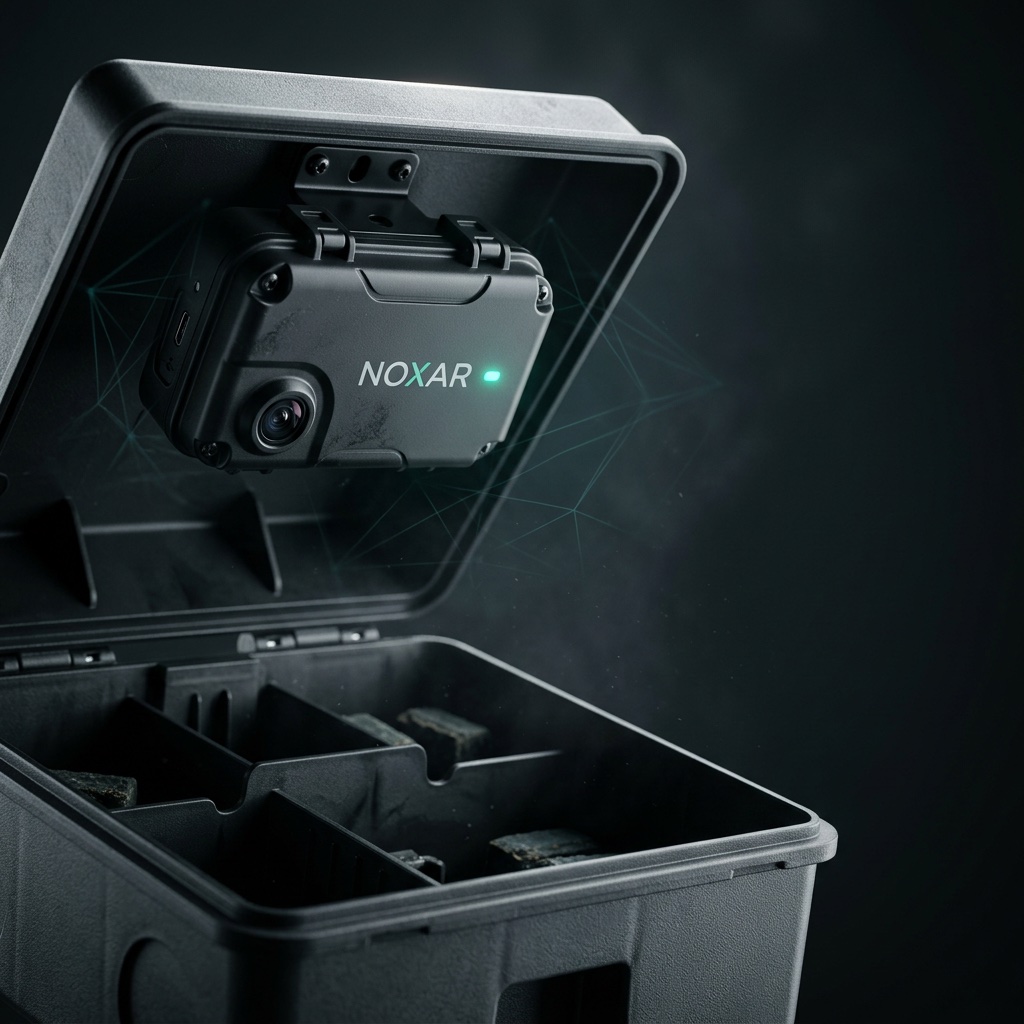
Clip-On Module

You've already spent money on boxes in the field. You don't have to replace them. The Clip-On attaches to any existing dumb trap in seconds. 300 boxes deployed across 25 client sites — all of them live on the Noxar platform by end of day, sending signals, logging alerts, feeding your dashboard. No replacement. No disruption. Your existing investment starts working.

$1 / box / month Hardware: one-time purchase · fits any existing box · no specialist installer needed
Noxar Water Sensor Noxar Water Valve
Water Prevention · Property Managers
Water Leak Detection System

A pipe fitting fails at 2am Saturday. Without Noxar: you find out Monday morning. With Noxar: the sensor detects moisture within seconds, the shutoff valve closes automatically, and you receive an alert with the exact location before the water has reached the floor. You call a plumber Monday morning. The repair is €400. Not €150,000.

€4–5 / sensor / month Hardware: one-time purchase · runs on same gateway as rodent module · no second infrastructure needed
Operator Platform

Every box. Every property.
One screen.

Web and mobile dashboard for pest control operators. Real-time portfolio view, instant alerts, and AI-powered route optimisation — built entirely in-house by our lead programmer.

An operator managing 400 boxes across 35 properties doesn't need more raw data. They need to know which three boxes need attention today, in what order to drive to them, and why. That's the only question the Noxar platform is designed to answer.

The dashboard aggregates every sensor stream across a portfolio into a single prioritised view. On a laptop before the morning briefing or on a phone between visits — the operator arrives at each site knowing exactly what to expect. Ghost visits become structurally impossible.

Route optimisation and the daily priority checklist are being built now. Both will be live before the first international operator deployment. Everything is built in-house — no third-party SaaS, no licensing cost, no external roadmap dependency.

noxar operator dashboard · portfolio overview
Live feed
487
Boxes Active
3
Need Attention Now
0
Ghost Visits This Month
Real-Time Portfolio Monitor

Every box across every client site visible in one place. Status, last signal, alert history, battery level. Full parity between web and mobile.

Live
Instant Alert System

Activity triggers immediate push notifications and a timestamped incident log. No polling. No lag. The operator knows within seconds.

Live
AI Route Optimisation

Daily routes built automatically — shortest path covering only the boxes that need a visit, ordered by urgency. Drive less. Find more.

In Development
Priority Checklist

Each technician starts with a ranked checklist — sorted by alert severity, trigger recency, and client priority. No decisions to make in the field.

In Development
Our Story

We didn't plan this
company. We discovered it.

For twenty years, Giorgi Rapava ran one of Georgia's professional pest control operations — 100 active clients, 5,000 monitoring boxes across warehouses, food facilities, and commercial properties. Every route was his. Every wasted callout was his cost. Fifteen percent of every visit found nothing.

The monitoring technology that could have fixed this existed — Rentokil and Anticimex had built it. But it was a closed platform, deliberately designed to pull independent operators toward acquisition. Use the technology, lose your company.

So Revaz Kakabadze — who had already shipped one commercial IoT device — built what Giorgi needed. An 8-sensor PCB, firmware rewritten in Rust for production reliability, a dual-protocol gateway. Open hardware. Operator-owned.

"Installing the gateway for rodent sensors, Revaz saw it. The same network, already deployed and paid for, could detect water leaks across the same properties. One conversation with a Georgian commercial property insurer confirmed the demand. Their exact words: a dream product."
01
20 Years of Operations
100 clients. 5,000 boxes. Giorgi knew every failure mode personally — ghost visits, delayed detection, wasted routes — because he funded every one.
02
Built Our Own Hardware
The smart monitoring that existed was a closed acquisition funnel. Revaz built the open alternative — 8-sensor PCB, Rust firmware, LoRaWAN gateway. His second shipped IoT device.
03
The LoRaWAN Insight
Installing the rodent gateway, Revaz saw it: the same network, already funded by pest control contracts, could detect water leaks across the same properties at marginal cost.
04
Insurer Validation
Georgian commercial property insurers confirmed suppressed demand immediately. Their response: "a dream product." The distribution channel was already waiting.
05
City Infrastructure
A LoRaWAN network at urban density reads gas and electric meters. Every service contract is a node. The network becomes a city asset — built without a separate capital raise.

The infrastructure compounds with every contract signed. Operators and property managers who need the services pay for the network that serves everyone else. No separate buildout. No infrastructure raise required.

The Problem

Two silent destroyers.
Neither gives a warning.

Both cause catastrophic, preventable damage. Both are invisible until the damage is already happening. Both have gone unsolved not because the technology didn't exist — but because it was locked away or priced out of reach.

Independent pest control operators still run fixed-schedule inspections with no real-time data — driving to every property on a timetable regardless of whether anything has happened. When they do find an infestation, it's been developing for two weeks. When they don't, the visit was wasted. The monitoring technology that could fix this belongs to Rentokil and Anticimex, and using it means surrendering your independence to them.

Meanwhile, water damage is the most common category of commercial property insurance claims globally. The average commercial incident runs to six figures. It typically starts with a fitting that fails overnight, on a weekend — and runs unchecked for 36 hours before anyone discovers it. The systems that could prevent it start at $5,000 and reach $150,000, accessible to large portfolios and invisible to the managers who need it most.

Rodent Infestations
15%
of all operator callouts find nothing — wasted fuel, time, and labour

Over 33,000 independent pest control operators across major markets run manual inspection rounds on fixed schedules with no real-time signal. Globally, rodent control is a $3.2 billion market growing at over 6% per year. In the US alone, rodents cause an estimated $20 billion in economic damage annually. Yet the technology to prevent it is deliberately kept inside closed systems designed to acquire the operators who need it.

  • Infestations develop over 2+ weeks undetected between scheduled visits
  • A single sighting in a restaurant can trigger closure, health inspection, or a public review
  • Smart monitoring exists — but only inside Rentokil, Anticimex, and Rollins
  • Open-market alternatives are either too expensive at scale or too limited to trust
  • 100+ acquisitions by consolidators in 2023 alone — the independent market is shrinking
Water Leak Damage
$13B
paid by US insurers annually in water damage claims

Water damage is the single largest category of commercial property insurance claims. In the US, insurers pay over $13 billion every year — and that figure has risen 33% over the past decade. In Australia, escape of water consistently ranks as the most frequent commercial claim category. A pipe that fails on Saturday night runs unchecked for 36 hours. The average commercial claim exceeds $100,000. Prevention technology reduces that by 90%. But nothing affordable and autonomous exists for the mid-size portfolios that need it most.

  • Water damage accounts for over 20% of all US commercial property insurance claims
  • In Australia, escape of water is the most common commercial building claim type
  • Claims frequency has risen 33% in a decade, driven by ageing infrastructure
  • BMS installations cost $5,000–$150,000 — inaccessible to 10–50 property portfolios
  • Basic moisture alarms alert but cannot act — the water still runs

"Both are invisible until catastrophic. Both need autonomous, always-on IoT response. Both share exactly the same gateway infrastructure."

System Architecture

Three revenue streams.
One gateway. Zero redundancy.

A single LoRaWAN gateway — deployed once, funded by the first service contract — powers three independent revenue streams, each one activating the next.

The insight is architectural. Pest control operators need remote monitoring. Property managers need water prevention. Both need LoRaWAN infrastructure to run their sensors. That same gateway covers the building and the surrounding urban area. Every device within range can use it. The operator pays for the gateway through their service contract. Noxar owns what the gateway enables.

Layer 01 · Immediate Revenue
Rodent Monitoring
Independent pest control operators — Georgia, Australia, US, UK

The Smart Mouse Box replaces dumb boxes for new deployments. The Clip-On retrofits any existing box in the field instantly. Both run the same firmware — 8 sensors, Rust stack, LoRaWAN connectivity. Operators move from driving fixed routes to responding only when the data tells them to.

  • Smart Box for new deployments · Clip-On for existing infrastructure — universal fit
  • 8-sensor detection: motion, acoustic, temperature, humidity, environmental
  • Built-in snap trap on Smart Box — autonomous elimination on confirmation
  • Rust firmware — production reliability, not prototype code
  • Real-time operator dashboard — web and mobile, built in-house
Hardware: one-time purchase by operator
$1 / box / month SaaS
Layer 02 · Recurring Revenue
Water Leak Detection
Property managers and commercial insurers

Moisture at a critical water point triggers autonomous shutoff in seconds — before a human wakes up, before a claim is filed. Runs on the same LoRaWAN gateway already installed for rodent monitoring. Insurance-grade timestamped incident documentation built in from day one.

  • Sensors at every critical water point — pipes, risers, plant rooms, basements
  • Autonomous shutoff valve: moisture detected → valve closed in seconds
  • Zero human response required — fully autonomous detection to shutoff
  • Insurance-grade incident log — timestamped, exportable, audit-ready
  • Reduces claim frequency 73% and average payout 90% (real-world deployments)
Hardware: one-time purchase by property manager
€4–5 / sensor / month SaaS
Layer 03 · Compounding Infrastructure
LoRaWAN Network
Gas utilities, electric meters, IoT companies, smart cities

As gateway density reaches urban threshold in a city, the network becomes the infrastructure every LoRaWAN device needs — gas meters, electric meters, logistics trackers, environmental sensors. Third parties pay per-device access fees. Zero marginal delivery cost.

  • Every gateway covers building interior and surrounding urban area
  • Dual-protocol: LoRaWAN + NB-IoT running simultaneously
  • Gas and electric meters read remotely via existing network
  • Third-party IoT companies pay per-device access fees
  • Zero marginal cost — revenue scales with every new service contract
No additional hardware cost — uses existing gateway
Per-device access fees

Shared LoRaWAN gateway infrastructure — deployed once per property, funded entirely by service contracts, powers all three revenue layers indefinitely. Two bets. One infrastructure. Either module wins alone. Both win together.

The Bigger Picture

What we are
actually building.

Noxar is not a pest control technology company that added water sensors. It is an urban IoT infrastructure company that uses service contracts to fund its own network buildout — a model with no direct precedent in the smart city space.

Every city Noxar enters follows the same logic. Pest control operators bring the first gateway deployments. Property managers bring water sensors and denser coverage. Insurer partnerships accelerate both channels simultaneously. When gateway density reaches urban threshold, the network begins generating infrastructure revenue from every device it serves.

Georgia is the first proof point. Australia is the first international expansion — a large independent pest control market with active consolidation pressure from Rentokil and Anticimex, and a commercial property insurance industry already looking for prevention partners. From there, the US and UK follow the same pattern. Every city adds nodes. Every node compounds network value.

We already have traction with a distributor who has agreed to facilitate market entry with independent operators in Australia — giving us a warm introduction into a market where we'd otherwise be starting cold.

How the network compounds
01
Operator signs up for rodent monitoring
A gateway gets installed at their client property. They pay $1/box/month. The rodent module pays for the gateway.
02
Property manager adds water sensors
Same gateway. No new infrastructure. Water prevention activates at marginal cost. City coverage grows denser.
03
Gateway density reaches urban threshold
Gas meters, electric meters, logistics sensors — any LoRaWAN device in the city now has a network to run on. Third parties pay access fees. Zero marginal cost of delivery.
$400M
Rodent SaaS TAM
33,000+ independent operators across first 5 markets at $1/box/month. Top-down and bottom-up estimates converge within 10%.
$1.4B
Water Prevention TAM
120,000 mid-size commercial property managers across first 5 markets at €4–5/sensor/month. Insurer distribution channel not included.
$27.7B
LoRaWAN Infrastructure TAM
Global smart meter market, 2024. Noxar doesn't sell meters. It owns the network they run on. Every service contract is a node.
Why Now

Five forces created
this window. None will wait.

01
Hardware Economics

IoT sensor costs fell over 60% in a decade. The always-on LoRaWAN architecture our 8-sensor PCB requires was not manufacturable at the right price point before 2022. It is now. Our unit economics are validated at Georgian scale before any international manufacturing commitment is made.

Sensor costs: −60% over 10 years
02
Consolidation Urgency

Rentokil, Anticimex, and Rollins executed over 100 acquisitions in 2023 alone. The pool of independent operators Noxar can sell to shrinks every year. This is not a market risk — it is a timing argument. Every year we wait, the addressable customer base contracts.

100+ acquisitions in 2023 by top 3 players
03
Insurance Industry Shift

Commercial property insurers are moving from paying claims to mandating prevention. Properties using water prevention technology file 73% fewer claims and reduce insurer payouts by 90%. Georgian commercial property insurers confirmed demand directly — their words: "a dream product."

−73% claim frequency · −90% average payout
04
LoRaWAN Ecosystem Maturity

LoRaWAN reached $3.7B in 2024, growing at 41% CAGR across 148 commercial networks in 162 countries. The component suppliers, certification bodies, and integration partners required to build and operate Noxar's proprietary urban network now exist at commercial scale in every target market.

$3.7B market · 41% CAGR · 162 countries
05
Smart City Mandates

Governments worldwide are mandating smart meter deployment under energy transition legislation. The global smart meter market stands at $27.7B in 2024, growing at 9.9% CAGR. LoRaWAN is the preferred protocol in multiple national frameworks. These are statutory deadlines — not discretionary timelines. Every city mandated to deploy smart meters is a potential Noxar network customer. We don't need to create the demand. It's already law.

$27.7B smart meter market · 9.9% CAGR · statutory deadlines
Traction

Built on conviction.
Zero external capital.

Every milestone below was reached self-funded. Nothing required external belief — only the founding team's.

The hardware architecture is complete. Our CTO has finished the 8-sensor PCB design, completed the C-to-Rust firmware rewrite for production reliability, and specified the dual-protocol gateway. Our first customer — an existing Georgian client managing four warehouses and 150 boxes — has given verbal commitment to deploy on prototype completion. That's not a cold prospect. It's a paying client who already knows the problem firsthand.

The rodent module prototype is weeks away and deploys first on our own Georgian operation. We are Pilot Customer Zero. The water module follows four months later on the same properties, using the LoRaWAN infrastructure already in place. Australia follows at month twelve, backed by a distributor relationship we've already established.

100
Active Clients
5,000
Boxes Deployed
20+
Years Operating
$0
External Capital
20+ year operational heritage — every metric is from real data100 active Georgian clients · 5,000 monitoring boxes deployed · 15% ghost visit rate from our CEO's own operational logs
Hardware architecture complete8-sensor PCB · LoRa Mesh networking · C→Rust firmware rewrite · dual-protocol gateway (LoRaWAN + NB-IoT)
Full founding team assembled, working full-time since late 2025CEO + CTO + COO + Lead Programmer — all self-funded, zero external capital drawn
First customer verbally committed to deployExisting Georgian client · 4 warehouses · 150 boxes · confirmed on prototype completion — not a cold prospect
Insurer demand validated — Georgian commercial property insurersDirect conversations · response: "a dream product" · suppressed demand confirmed · distribution channel forming
Australia distributor relationship establishedExisting distributor relationship · soft commitment to facilitate operator introductions · warm entry into the AU market
Rodent module prototype — weeks awayFirst deployment on our own Georgian operation · Noxar is Pilot Customer Zero
Water module prototype — 4 monthsSame Georgian properties · leverages existing LoRaWAN infrastructure already in place
Australia — first international operator by month 12RCM certification pathway scoped · ACMA SDoC compliance identified · AU/NZ hire funded by this round
The Team

The operators who
built the technology.

Not engineers who studied the problem. People who paid for it professionally and built the solution they couldn't buy anywhere else.

Every domain critical to this business is owned in-house. Hardware, firmware, SaaS, operations, and investor relations — no external contractors, no vendor roadmap dependency. Our CEO is the customer, with 20 years of operational data behind every product decision. Our CTO has shipped commercial IoT hardware before. Our Lead Programmer has owned production software since age 15.

CEO · Co-Founder
Giorgi Rapava
Chief Executive Officer

Twenty years running Balaveri — Georgia's professional pest control operation. Started as a field technician, specialised in deratisation, scaled to 100 active clients and 5,000 deployed boxes. The 15% ghost visit rate, the two-week detection gap, the wasted callout cost — these numbers come from his own operational logs. He didn't study this problem. He paid for it, every month, for two decades. He is the customer.

20yr operations · customer insight · investor relations
CTO · Co-Founder
Revaz Kakabadze
Chief Technology Officer

Engineering degree. Prior startup: GPS tracking device, designed both hardware and firmware for battery-powered IoT deployed commercially. This is his second connected device — the first one shipped to paying customers. Owns the full hardware-firmware boundary at Noxar: 8-sensor PCB, LoRa Mesh architecture, Rust firmware, dual-protocol gateway. AU/NZ RCM certification already scoped at component level.

PCB design · Rust firmware · LoRaWAN architecture
COO · Co-Founder
Giorgi Kvirkvelia
Chief Operating Officer

Operations management at Majorel and Teleperformance from age 18 — two of the world's largest BPO firms, each coordinating across dozens of countries simultaneously. Diplomacy studies and embassy internships alongside. Manages development coordination across engineering, product, and commercial, and leads investor outreach and operator partnerships with the CEO.

International ops · market entry · investor relations
Lead Programmer · 19
Giorgi Grigalashvili
Lead Software Engineer

Building production software since age 15. Four years of development before joining Noxar full-time. Owns the complete SaaS platform: operator dashboard, alert processing engine, cloud backend, API layer, and AI route optimisation in development. Zero external frameworks in the critical path. Zero licensing cost. The platform roadmap has no external dependency — it moves at whatever speed the hardware team requires.

SaaS platform · cloud backend · AI route optimisation
Raising $300K Pre-Seed

Four workstreams.
Three binary milestones.

The idea is proven at operational scale. This round funds the transition from proven concept to investable seed-stage company.

Three milestones define this round: a validated product running on a live Georgian operation with real data, a production SaaS platform with the first paying operator, and an active Australian operator deployment. Each milestone is binary — either done or not done. No partial credit.

The outcome is a $3–5M seed round at materially higher valuation. Every workstream is sized against what it takes to reach that outcome — not against what would be comfortable to spend.

35%
Hardware Production
Prototype to manufacturable product at viable unit economics. Both rodent and water modules. Volume pricing validated at Georgian scale before any international manufacturing commitment.
30%
SaaS Platform
Production-ready operator dashboard, alert system, portfolio management, incident documentation. Full in-house — no third-party SaaS in the critical path. No licensing cost.
20%
Australia Entry
RCM certification, ACMA compliance, AU/NZ operations hire. The ACMA SDoC signatory requirement cannot be fulfilled remotely from Georgia. Non-negotiable for legal commercial deployment.
15%
Corporate Structure
UK Ltd or Delaware C-Corp international holdco. Georgia Virtual Zone IT registration (0% CIT on international SaaS). Founder agreements, IP assignment, clean cap table.

Milestone outcome: validated product on live Georgian operation · production SaaS with first paying operator · Australian operator in active deployment · $3–5M seed round at materially higher valuation

For Pest Control Operators

Apply for the Pilot Programme

We're selecting a small group of independent operators for first deployments. You get early access, preferred pricing locked in for 24 months, and direct access to our engineering team. We get real operational data and honest feedback.

Apply for Pilot
For Operators & Property Managers

Ready to Deploy Noxar?

If you're an operator or property manager ready to move beyond a pilot and commit to deploying Noxar across your portfolio, submit a letter of intent. We'll be in touch within 48 hours to scope your deployment.

Submit LOI
For Investors

Interested in the Raise?

We're raising $300K pre-seed from investors who understand the infrastructure thesis — not just the pest control product. If you'd like to learn more or receive the full deck, send us a note and we'll be in touch.

Investor Enquiry